Read More
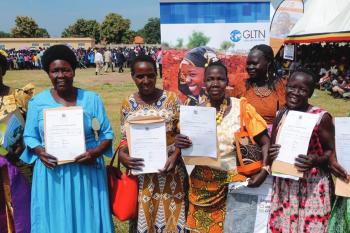
Gender Strategy for Land-at-Scale Uganda
Women’s Land Rights (WLRs) are fundamental human rights, foundational to gender equality and women’s dignity and instrumental in improving food security, effective climate action, poverty eradicati

This article provides a review of the past and potential future roles of land tenure reforms and land markets in Sub-Saharan Africa (SSA) as responses to population growth in the process of land use intensification and livelihood transformation. The farm size distribution and the existence of an inverse relationship (IR) between farm size and land productivity in SSA and the implications of this relationship for efficiency and equity are investigated.
More secure property rights and removal of restrictions on land markets have the potential to create both efficiency and equity benefits, but there are high risks of elite capture of large land areas with inefficient and inequitable outcomes. This situation is the case not only in land-abundant areas but also in urban and peri-urban areas where increasingly larger proportions of people will make their living. Increasing population pressure in densely populated rural areas contributes to more rapid rural–urban migration, and creating alternative livelihood opportunities for the migrating youth population is essential to achieving economic development with social stability.
Women’s Land Rights (WLRs) are fundamental human rights, foundational to gender equality and women’s dignity and instrumental in improving food security, effective climate action, poverty eradicati
This publication presents a summary of UN-Habitat’s gender equality impact over the past five years, in line with the Beijing reporting cycle.
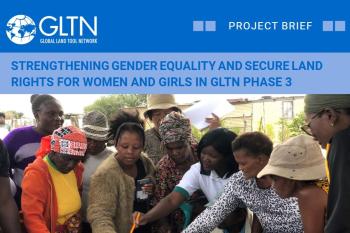
GLTN’s institutional commitment to gender equality and secure land rights for women and girls has been at the core of its work since inception in 2006.